


One Door to the Truth: What South Africa's Real411 Could Teach Ghana about Life After the Debunk

Ghana has an active fact-checking community and, in the country’s last general election, formed a coalition comprising DUBAWA, Media Foundation for West Africa, and FactSpace West Africa to spot and debunk harmful narratives.
South Africa's five-year-old complaints portal, Real411, offers Ghana a possible model for holding harmful online content to account. But its experience also shows that a portal alone cannot compel social media platforms to act.
Ask Rabiu Alhassan, Executive Director and Managing Editor of FactSpace West Africa, which runs GhanaFact, what happens after his newsroom publishes a fact-check, and the honest answer is complicated. A fact-check is not the finish line, he says – it is supposed to be a lever.
"Fact-checks are not an end in themselves. They literally are supposed to be a means to an end," Alhassan said.
In practice, that lever works well on people with reputations to protect. GhanaFact has secured on-the-record corrections from Members of Parliament (MPs), presidential candidates and public figures, including, Alhassan said, Ghana's current Minority Leader, over a claim about illegal sand-winning that nearly sparked a floor confrontation between MPs.
The lever slips with anonymous accounts that profit from engagement rather than reputation. Asked whether he could recall a viral content creator issuing a correction after a debunk, Alhassan drew a blank. "I don't have any of those examples on top of my head," he said.
That gap, between what a fact-check can do to a named public figure and what it can do to an anonymous repeat offender, is what this story sets out to explore, using a five-year-old South African tool, Real411, as a point of comparison.
What Real411 actually does, and does not
Real411 is a free, public complaints portal run by the Johannesburg-based nonprofit Media Monitoring Africa, now known as Moxii Africa.
First launched for South Africa's 2019 elections, then relaunched in March 2020 as a permanent, year-round platform, it lets anyone report suspected disinformation, hate speech, incitement to violence or harassment of journalists across any platform, in one place.
A complaint is assessed by at least three reviewers, finalised by a senior secretariat member, and published – reasoning included – in an archive dating to 2020.
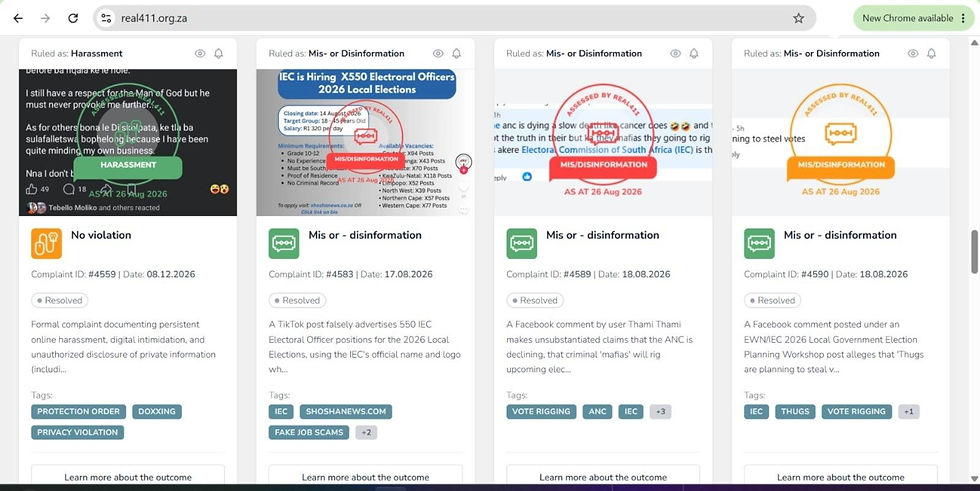
A screenshot of Real411's public archive shows recent rulings on complaints of suspected information disorder. (Real411/Moxii Africa)
It is worth being precise about what that process can and cannot do. Real411 does not itself remove content or order a platform to act: it has no such authority.
What it has is a Framework of Cooperation, renewed for the 2024 election, under which Moxii Africa, the Electoral Commission, Google, Meta and TikTok agreed that confirmed violations could be referred to the relevant platform for action under its own policies – removal, a warning label, delisting – or to the Electoral Court.
The review is non-binding, and an unhappy complainant can appeal to a process overseen by retired Constitutional Court judge Zak Yacoob.
The 2024 election drew roughly 200 complaints, and the pattern behind them is instructive: X accounted for 68% of disinformation complaints, WhatsApp 15%, and YouTube 8%.
The WhatsApp figure carries a familiar caveat – content within encrypted, private groups is largely invisible to external monitoring, a limitation South African reviewers wrestle with as much as Ghanaian reviewers would.
Ghana already crowdsources; it does not yet adjudicate
The instinct that Ghana is missing a public complaints channel is only partly right.
GhanaFact has run a WhatsApp tip line for more than five years, alongside a chatbot that accepts text, images and video from the public and either surfaces an existing fact-check or flags the claim for investigation, plus an interactive voice response system in Dagbani, Hausa and Twi built for rural and offline audiences who would never see a fact-check published in English on a website.
Alhassan does not see Real411 as introducing a capability Ghana lacks so much as packaging one it already has differently. "It is not too far off from some of the things we are also doing," he said, allowing that a Real411-style system "can be an add-on."
Where Ghana has built something closer to Real411's coordination function is around elections.
Ahead of the December 2024 polls, GhanaFact joined Dubawa Ghana and Fact Check Ghana – Ghana's three International Fact-Checking Network (IFCN) signatories – to form the Ghana Fact-Checking Coalition, running situation rooms in Accra and Tamale and distributing verified information through more than 100 media outlets in 45 Ghanaian languages.
Of the misinformation it tracked, video accounted for 40%, images 29%, text 26%, and audio the rest; a breakdown that hints at how much of the problem sits beyond a text-based fact-check's reach.
The National Media Commission’s (NMC) executive secretary, George Sarpong, later called the coalition the single greatest innovation of the 2024 election.
But the coalition, by design, is an election-season instrument. Its situation rooms opened in early December 2024 and wound down after the vote, with a post-election report the following January as its main lasting output.
It monitors and debunks at scale; it does not, like Real411, maintain a standing, searchable archive of individually ruled-on complaints a citizen could consult in an ordinary week.
Much like GhanaFact, Dubawa Ghana runs a comparable WhatsApp chatbot, launched in May 2024; Fact Check Ghana, the coalition's third member, takes tips the more traditional way, by direct email. Different doors, same idea: crowdsourced reporting is not central to any of them, but it is not new to Ghana either.
The regulator question
Any version of this conversation runs into the question of who would run a Ghanaian equivalent, and each existing candidate has a mandate that only partly overlaps with the job.
The National Media Commission already has a statutory complaints mechanism: under the National Media Commission Act, 1993, its Complaints Settlement Committee can investigate grievances involving the press and mass media and order corrections, apologies or disciplinary action.
In November 2024, it added a technology layer, the Ghana Media Watch App, letting the public submit problematic broadcast content for real-time review. But both mechanisms are built around registered media houses; neither was designed to adjudicate a complaint against an anonymous TikTok account, which is where much of Ghana's viral misinformation now lives.
The Cyber Security Authority (CSA) occupies an adjacent but distinct lane.
Established under the Cybersecurity Act, 2020, to prevent, manage, and respond to cybersecurity threats and regulate critical infrastructure. Furthermore, the CSA ran cybersecurity education across 32 districts ahead of the 2024 election, warning that malicious actors were using deepfakes to target disinformation at specific ethnic groups, and said its response would include working with TikTok, X, and Facebook to initiate takedowns where necessary.
But an authority built to investigate phishing, account takeovers and infrastructure attacks is not equipped to determine whether a politician's Facebook claim is misleading.
That call takes a different kind of expertise, and independence from government, than a cybersecurity regulator is built to have.
What worries Ghanaian fact-checkers more
Pressed on where Ghana's real accountability gap lies, Alhassan did not first point to the absence of a portal. He pointed to the platforms.
"There's the obvious big gap of the internet platforms not doing enough to sanitize their platforms," he said, arguing that Meta and TikTok invest less in moderating Ghanaian content than they do in the Americas and Europe.
He cited an investigation his newsroom ran into how bad actors exploited social media to entrench the Bawku conflict in the Upper East Region, a case that took more than three years of platform inaction before Meta and TikTok responded, and even then, not adequately.
The second gap he named was digital literacy: the public not knowing how to use the reporting tools platforms already provide. Both problems sit upstream of anything a Ghanaian Real411 could fix alone – a portal is only as effective as the platforms' willingness to act on it, the relationship South Africa spent years, several elections and a pandemic building.
The risk flagged first
Ask how Ghana could pursue platform accountability without curdling into censorship, and Alhassan answers from regional memory rather than theory.
"We do not have a so good experience when it comes to how governments in this part of the world have used legislation to cow their political opponents," Alhassan said. "We tend to hasten slowly when it comes to recommendations for legislation."
His preferred model is not a state-run adjudication body at all, but government working alongside civil society to co-design any enforcement mechanism, with independent fact-checkers positioned to publicly expose any attempt to turn an anti-disinformation tool into a political weapon – a check built into the process rather than bolted on after.
South Africa's own model carries the same tension by design: its process is non-binding, its rulings are public, and its appeal sits with a retired judge rather than a government official.
What this means for Ghana
Real411's real innovation may not be the complaints portal itself, which Ghana has functionally replicated in pieces through GhanaFact's tip lines and the election coalition's situation rooms.
It is that South Africa built a standing, rules-based, publicly archived adjudication layer that platforms have agreed to act on – year-round, not just during elections – and that has survived five years and three national polls without becoming a tool for silencing critics.
Ghana has the fact-checking capacity, and, during elections, the coordination. What it lacks is a standing body – trusted by civil society, credible to platforms, insulated enough from whichever party holds power – that can turn a debunked claim into a consequence for the account still profiting from it.
Building one is less a technology problem than a trust problem, and Ghana's own fact-checkers are the first to say they would rather build that trust slowly than lose it fast.


Comments